
Service
Garage Door Off Track? Here's What's Actually Going On
Fast, honest repair for a garage door that's jumped its track in Santa Clarita. We explain why it happens here, what to expect, and when replacement beats repair.
- Licensed & Insured
- Same-Area Service Calls
- Upfront Pricing
What Happens When You Call
-
1
Call or Request a Quote
Tell us what the door is doing and roughly how old the house is - that alone points us toward the likely part before a truck leaves.
-
2
On-Site Diagnosis
A tech checks the spring, cables, tracks, and opener in person and tells you plainly what is actually wrong.
-
3
Straight Price, No Surprises
You get a number before any work starts. It covers parts and labor, nothing added after the fact.
-
4
Fixed the Same Visit
Most repairs are done in one trip. If a part needs sourcing, we tell you that upfront instead of guessing.
How Long It Takes
A door off track is usually a same-visit fix, not a multi-day job. Once we're looking at it, the tech has to check three things before touching a wrench: whether the track itself is bent, whether a roller has snapped or popped out of its channel, and whether the cable came off the drum at the same time the door jumped. If it's just a roller out of the track with no bent rail, that's often 45 minutes to an hour of work.
If the track is bent - which happens more than people expect on the older single-car doors common in this area - straightening or replacing a section adds time, and if the door's wide enough that we need a second person to hold it square while we reset the track, that's built into the visit too. What we won't do is quote a time before we've seen the door. A door that's been off track for a week because someone kept trying to force it down can have a cracked stile or a torn panel seam that wasn't there on day one, and that changes the job.
We don't schedule off-track calls as routine maintenance slots. If the door is stuck open or stuck shut and it's blocking a car in or out, that's treated as the priority it is.
How It Shows Up
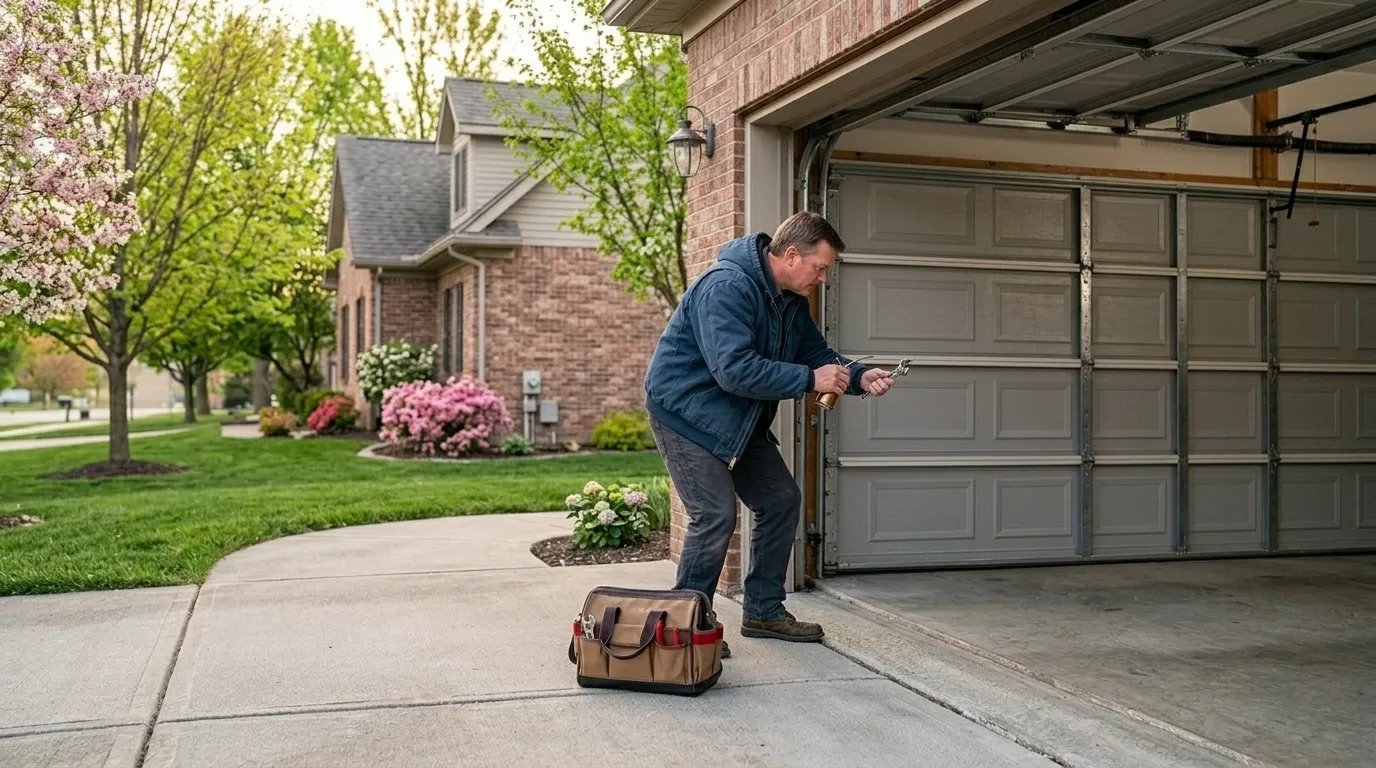
Most people notice it the same way: the door is running crooked, one side is lower than the other, or it stopped mid-cycle and now won't move at all in either direction. Sometimes there's a bang first - a roller letting go inside the track - and sometimes it's quieter, just a slow drift out of square over a few weeks that finally jams the door solid.
On the older torsion setups still common on houses from the 1960s and 70s stock that makes up most of this area, the failure often starts at the bracket where the horizontal track meets the vertical rail. That bracket takes the twisting load every time the door opens, and once a screw backs out, the whole track shifts a fraction of an inch - enough for a roller to walk right off the edge.
We also see it show up as a door that looks fine sitting still but grinds or shudders partway through the cycle. That's usually a track that's still attached but no longer parallel to the door's travel, which is different from a full derailment and matters for how we approach the fix.
Either way, the fastest way to make it worse is to keep hitting the opener button hoping it'll seat itself back in. It won't, and forcing it usually turns a bracket repair into a track and roller replacement.
The Cost of This Job
We're not going to put a number here that doesn't hold up once we're standing in front of your door. The cost of an off-track repair depends on whether it's a bracket and roller adjustment, a bent track section, or a track plus cable and drum situation - those are three different jobs wearing the same symptom. What we can tell you is what drives the price up: a bent rail almost always costs more than a popped roller, because a bent rail usually means replacing the section rather than just re-tightening it, and a two-car door needs more hardware and more labor time than a single.
With median household income across the service area at $119,775, we see a fair number of owners who'd rather pay for a proper track and roller replacement once than have the door limp along and fail again in six months. That's a reasonable call on an older door. It's a less reasonable call if the door itself is near the end of its life anyway - in that case, sinking money into track hardware on a door that's about to need a spring or panel replacement too isn't the job we'll recommend, even if it's the job you asked for.
Why This Fails Locally
This isn't a fault that shows up evenly everywhere. Housing across this service area was mostly built between 1956 and 1999, with the bulk of it - across the 13 named communities we cover - dating from the 1960s and 70s.
That means a lot of original or first-generation replacement track hardware, mounted with the fastening standards of that era, still doing the job forty-plus years later. Track brackets from that period were often screwed straight into framing without the reinforcement that's standard now, and forty years of door cycles is a lot of vibration on a screw that was never meant to hold that long.
The climate here plays a role too. This is a moderate heat band, not an extreme one, but the daily swing between a hot garage interior and cooler morning temperatures still puts steady expansion and contraction stress on steel and aluminum track sections, season after season. On a newer bracket that's not a problem.
On forty-year-old hardware that's already a little loose, it's the difference between a track that holds and one that walks. With around 33,875 households in the service area and about 19,719 owner-occupied houses, most tied to that same building era, this isn't a rare complaint - it's one of the more predictable calls we get, town after town, from Stevenson Ranch out to Canyon Country.
Talk to a Technician Before You Book
Describe what the door is doing and get a straight answer on what it likely needs.
Jobs Like Yours
Recent work from this service line.
Why Santa Clarita Calls Us
Frequently Asked Questions
Can I push my garage door back onto the track myself?
We don't recommend it. A door under spring tension that's off track can drop or swing unexpectedly, and forcing a roller back into a bent section usually damages the track further. If the door still moves at all, leave it where it is and call rather than trying to muscle it back into the channel.
Is a bent track always a replacement, or can it be straightened?
It depends on how far it's bent and where. A minor kink near a bracket can sometimes be straightened in place. A bend further along the rail, or one that's cracked the metal, usually needs the section replaced - reusing a stressed track section is a false economy since it tends to fail again.
Why does this happen more on older houses in this area?
A lot of the housing here dates from the 1960s and 70s, and track hardware from that era was fastened directly into framing without today's reinforcement standards. Decades of door cycles and normal seasonal expansion work those fasteners loose gradually, which is why older houses see this more than newer construction.
Need Garage Door Off Track? Here's What's Actually Going On?
Call now for straight answers on cost and timing.